
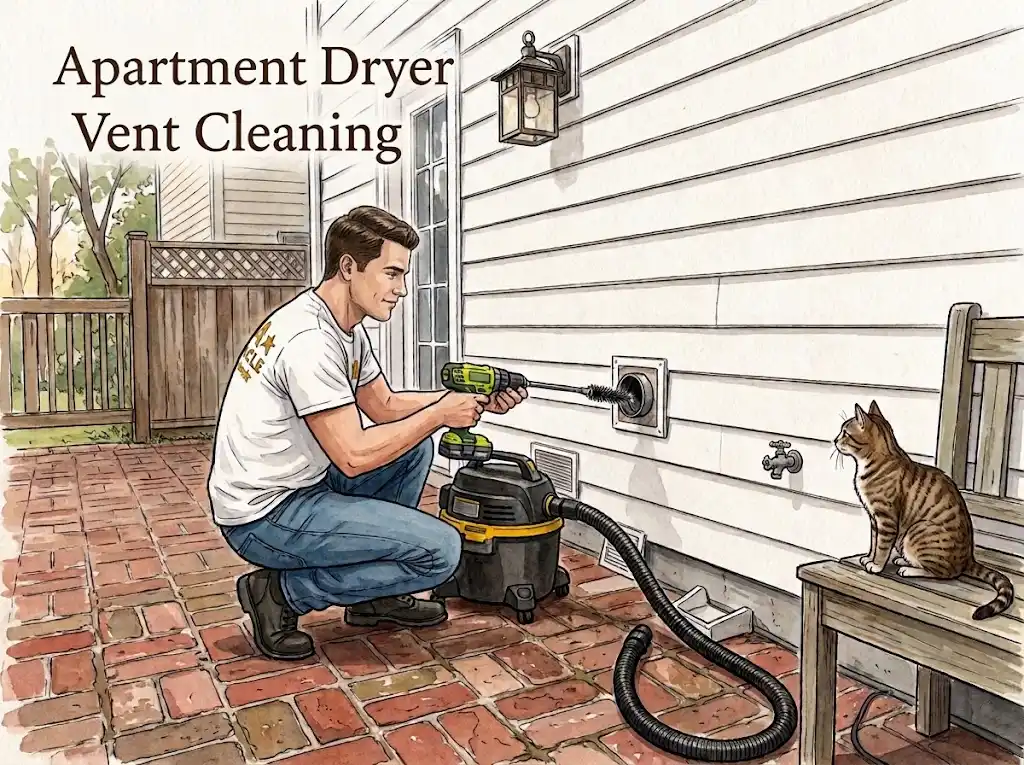
In most apartment buildings, dryer vents should be cleaned every six months. Once a year suits a short vent with light use, but apartment and condo vents are rarely short. In a lot of buildings, several units’ dryers feed into a single shared exhaust stack, which is longer, has more turns and carries lint from more than one household. If your unit has a long run, heavy use or a shared stack, plan on every six months.
The vent line is only one part of the system. The lint screen, the secondary lint trap where one is fitted, and the building’s shared stack each need attention on their own schedule, and they are not always the same person’s job. This guide covers how often each part needs cleaning, who usually looks after it, and the signs that a unit’s vent can’t wait.
How Often Each Part Needs Cleaning
An apartment dryer system has four parts that need attention, and each one runs on a different schedule.
| Part | How often | Who usually handles it |
|---|---|---|
| Lint screen | After every load | You |
| Secondary lint trap, where fitted | Check monthly | You, in about two minutes once you know where it is |
| Your unit’s vent line | Every six months for long runs or heavy use, once a year for short runs and light use | A professional cleaner |
| Shared exhaust stack | On the building’s maintenance schedule | Building maintenance |
Empty the lint screen after every load, not every few loads. It keeps a lot of lint out of the line, but it does not replace cleaning the vent itself.
Why Apartment Dryer Vents Clog Faster
Condo laundry is the dryer vent problem we see most in Vancouver, and it comes down to distance and sharing.
- Shared stacks: When several units feed one stack, lint from every household collects in it. Your vent can be restricted through no fault of your own.
- Bends and elbows: This is where blockages actually form. Every elbow adds resistance, and shared stacks have more turns than a house vent.
- Booster fans: On a long run, the dryer’s own blower can’t push air the full distance, so an in-line booster fan is fitted. That usually happens once the run goes beyond roughly 25 feet with no bends, and sooner when there are bends. Lint on the blades makes the fan work harder until it burns out.
- Exterior hoods: Birds nest in the hood and the last section of pipe, especially in spring.
Lint Screen, Secondary Trap and Vent Line Are Different Jobs
Cleaning one of these parts does nothing for the other two.
The lint screen is the filter you pull out of the dryer door. It catches most of the lint, but not all of it.
The secondary lint trap is a second catch point in the line. If you live in a condo or a high-rise, there is a reasonable chance your laundry setup has one. In multi-unit buildings the usual recommendation is to clear it monthly, which is far more often than the vent itself. If you’re not sure your unit has one, ask your building manager.
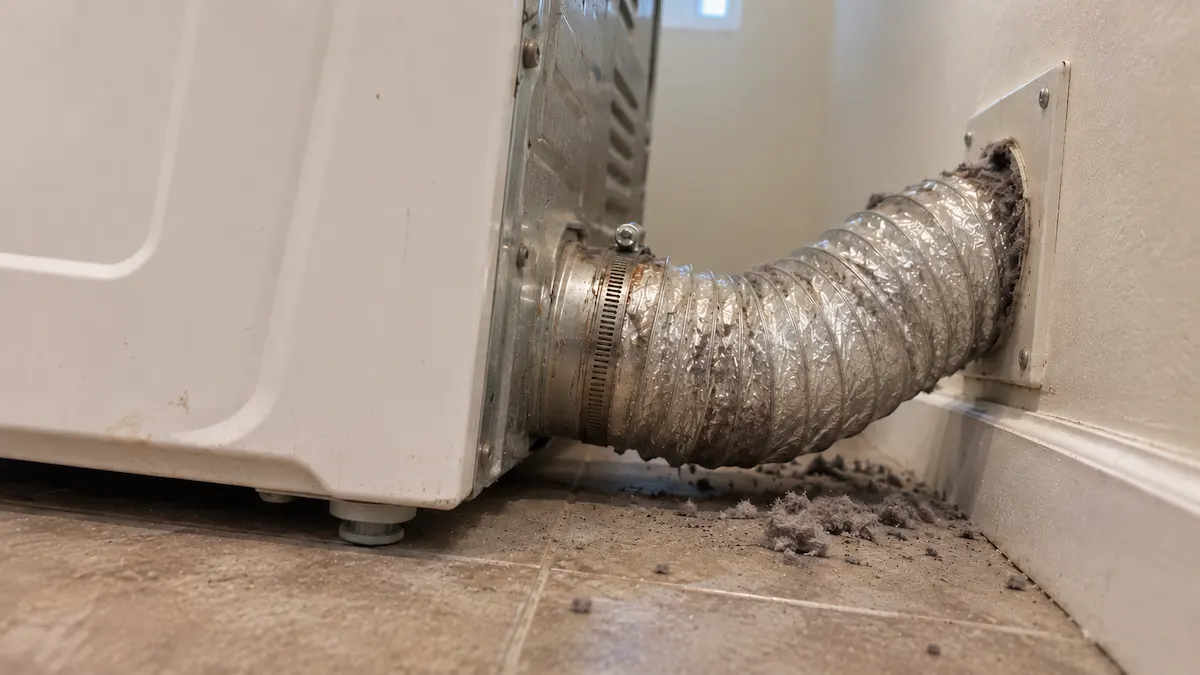
The vent line runs from the back of the dryer to the exterior. The worst of the lint usually sits right behind the machine, in the flexible transition hose, where it compacts. Cleaning this part takes rods, brushes and access to the full run, which is why it is a professional job.
Who Is Responsible in a Condo or Apartment
Responsibility usually splits between what serves only your unit and what serves the whole building. A restriction in the shared stack is building maintenance rather than a unit-level job, and cleaning your own line won’t fix it. Who books and pays for your unit’s line depends on your strata bylaws or your rental agreement, so check with your strata council or property manager first.
These are the questions worth asking your building manager:
- Does the building have a shared exhaust stack, and when was it last cleaned?
- Is there a secondary lint trap or a booster fan in my unit’s line?
- Who books and pays for cleaning my unit’s vent line?
- Do contractors need a service elevator booking?
We can also talk to your building manager directly. If the restriction turns out to be in the shared stack, we’ll tell you so, rather than charge you for a clean that won’t help.
Signs Your Unit’s Vent Needs Cleaning Now
Don’t wait for the six-month mark if your dryer shows any of these signs. Any two of them are worth a call.
| Sign | What to do |
|---|---|
| Clothes still damp after a full cycle, or needing a second run | Check the lint screen and the secondary trap. If both are clear, the vent line needs cleaning |
| The dryer or the laundry room is noticeably hot while it runs | Book a vent cleaning |
| A burning or scorched smell during a cycle | Stop the cycle and don’t use the dryer until the vent is checked |
| Lint collecting on the floor behind or under the machine | Check the transition hose behind the dryer, then book a cleaning |
| The flap on the outside hood barely lifts, or doesn’t move, while the dryer runs | Air isn’t reaching the exit. Book a cleaning |
| No lint coming out of the exterior vent during a cycle | It sounds like good news and isn’t. Lint is collecting somewhere in the line |
In a high-rise, the exterior hood may be out of reach. If you can’t see it, go by the first four signs.
Gas Dryers Need a Separate Check
If your unit has a gas dryer, a blocked vent is a carbon monoxide concern as well as a lint problem. Technical Safety BC warns that vent restrictions can cause exhaust leaks, which may contain carbon monoxide. It advises having gas dryers maintained or serviced by a licensed gas contractor at least once a year, or as the manufacturer’s instructions say. Cleaning the vent keeps air moving, but it does not replace that service.
What a Professional Apartment Vent Cleaning Includes
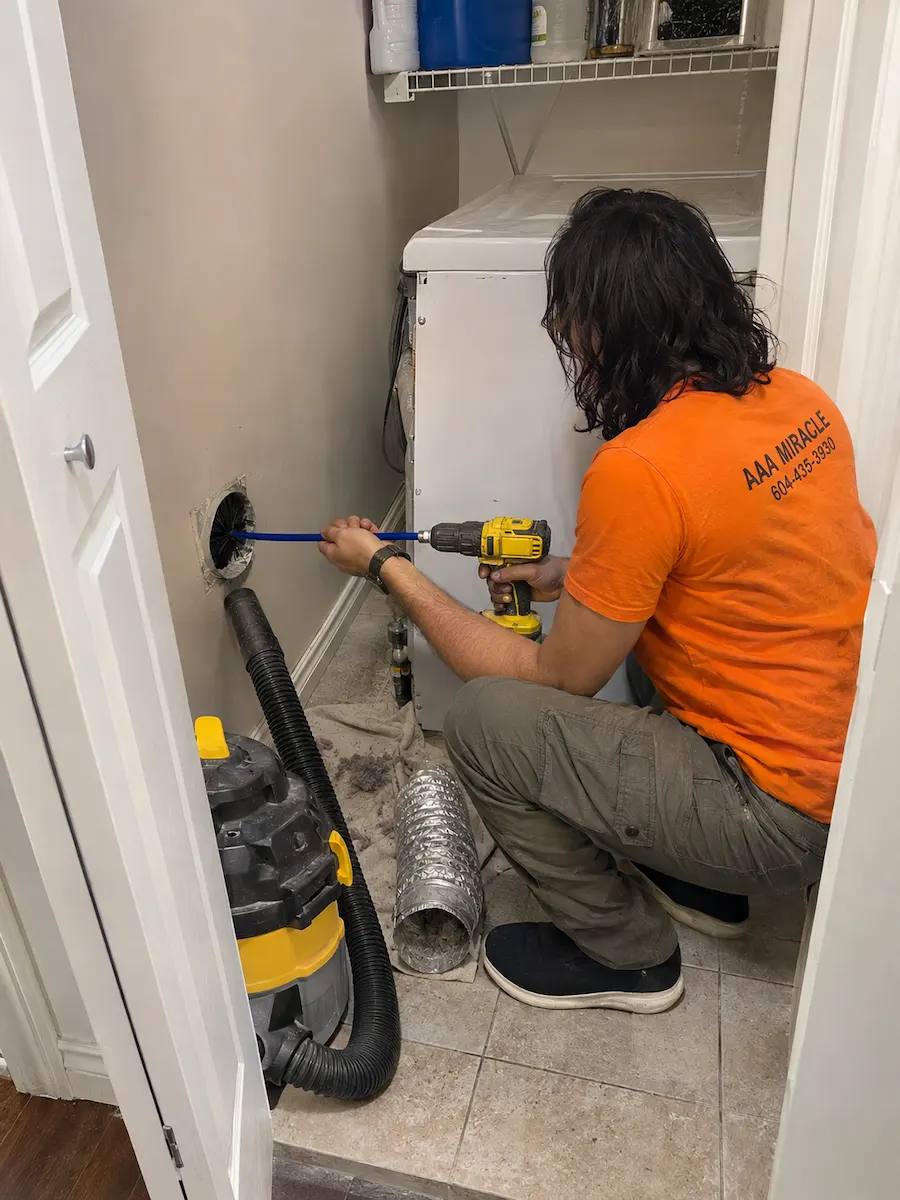
A proper clean covers the full line, from the back of the dryer to the exterior. That includes the transition hose, the bends and elbows, the exterior hood, flap and screen, the secondary lint trap where one is fitted, and the booster fan housing and blades where one is installed.
The visit runs in five stages:
- Inspection. We find the vent run, the exit point, and any booster fan or secondary trap. In a condo, this part often takes longer than the cleaning.
- Dryer disconnect. The dryer is pulled out and the transition hose removed.
- Mechanical cleaning. Rotating brushes on flexible rods work the full length of the line while a vacuum holds the debris.
- Exterior hood. The flap, screen and last section of pipe are cleared.
- Airflow check. Airflow is confirmed at the exterior hood with the dryer running, before the machine goes back.
Our dryer vent cleaning for condos and apartments is a flat rate that includes the secondary lint trap where one is fitted. Booster fan cleaning is an add-on, and roof-vented or hard-access lines are quoted on site. You get the final number before we start, and the price is discounted when the vent is cleaned in the same visit as air duct cleaning.
Preparing for the Appointment
In a condo, access is often the slowest part of the job, so a little planning saves time on the day.
- Book the service elevator if your building needs one, and let us know when you book.
- Tell us whether the dryer is stacked or in a closet.
- Clear the space in front of the laundry closet so the dryer can be pulled out.
Every six months is the right starting point for most apartment and condo vents, with a monthly check on the secondary lint trap in between. If your dryer is taking longer than it should, or the line hasn’t been cleaned in over a year, request a free estimate and we’ll tell you whether the problem is in your unit or in the building’s stack.