
We should say up front: we’re a carpet cleaning company, so you’d expect us to tell you to clean. Most of the time that is the right answer, because most carpets that look finished are dirty rather than worn. But some carpets really are done, and paying to clean one of those is money wasted. This guide is about telling the two apart, and about the options in between that most people don’t know exist.
First, Is It Dirt or Damage?
Three checks, five minutes, no tools. Compare it with a protected patch: Look inside a closet or under a heavy chair, where the carpet hasn’t been walked on, and compare that patch with the walkway. If the walkway is greyer but the pile is about the same height, it’s dirty. If the walkway is noticeably thinner and flatter, it’s worn. If the whole room is paler than the protected patch, especially near the windows, that’s sun fading, which no clean reverses. Rub a damp white cloth: Press a slightly damp white cloth into the darkest traffic lane and rub firmly. If it comes up grey or brown, there’s soil in that carpet that a clean will take out. Check the stair edges: The front edge of each step takes more wear than anywhere else in the house. Part the pile with your fingers. If you can see the backing showing through, or the tufts come away when you pull lightly, the carpet is wearing out from the base, and cleaning won’t put fibre back.
What Cleaning Can and Can’t Fix
| Problem | Will a professional clean fix it? |
|---|---|
| Grey traffic lanes in hallways and in front of the sofa | Usually, yes. They’re mostly packed-in soil |
| A dull, tired look across the whole room | Usually, yes |
| Old spills and food stains | Often, depending on what they are and how long they’ve been there |
| Pet urine smell | Often, if the underlay isn’t saturated |
| Pile that’s crushed under furniture or in walkways | Partly. Grooming lifts some of it, but badly matted pile may not recover |
| Bleach spots or pale patches | No. That’s missing dye, not dirt |
| Burns | No |
| Backing showing through, tufts pulling out | No |
| Fading on the window side of the room | No |
| Ripples and bumps | No, but they’re not a reason to replace either (see below) |
| Mould in the underlay | No. That’s a removal job for a specialist |
If most of what you’re seeing is in the top half of that table, clean first. If it’s in the bottom half, cleaning won’t solve it, and it’s worth looking at the options below before you jump to full replacement.
The Options Between Cleaning and Replacing
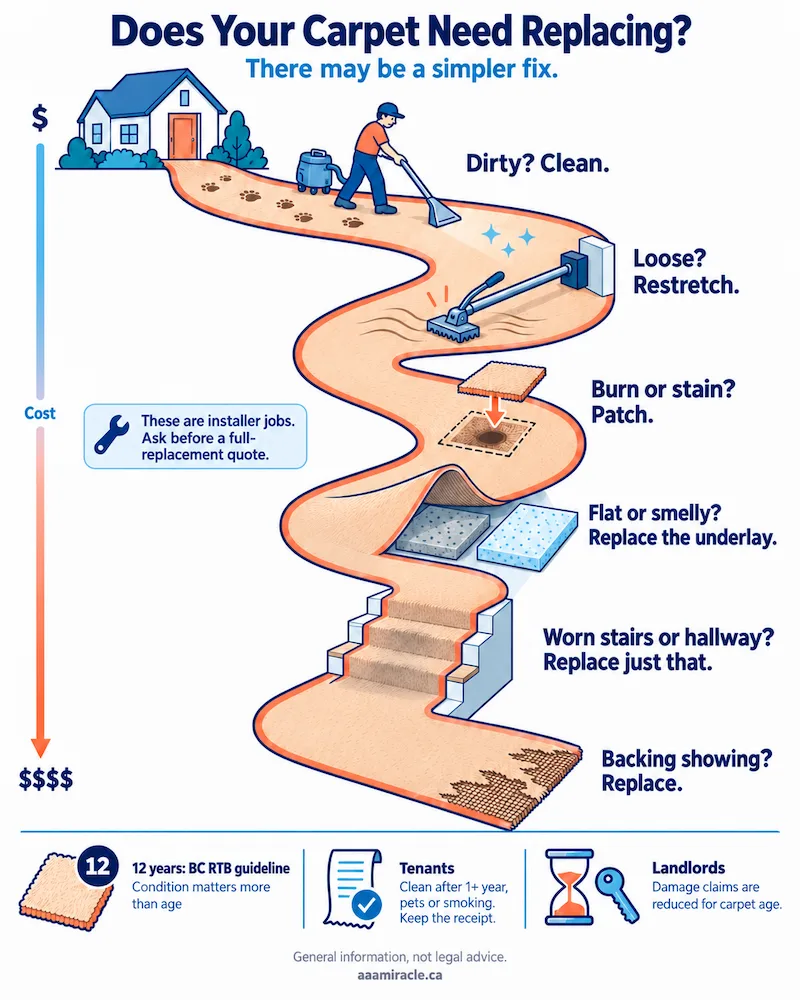
This is the part most guides skip, and it’s where a lot of money gets saved. Restretching: Ripples, waves and bumps usually mean the carpet has come loose from its tack strips and needs stretching back tight. It’s a carpet installer’s job, it’s much cheaper than replacing, and it makes the carpet safer to walk on. Patching: A burn, a bleach spot or a small torn area can often be cut out and replaced with a matching piece. Check the garage, the basement or a spare closet for an offcut from when the carpet was laid. If there isn’t one, an installer can sometimes take a piece from inside a closet, where no one will see the patch. Replacing the underlay only: If the carpet looks fine but feels flat and hard underfoot, or a smell keeps coming back from below, the problem may be the underlay. It’s the cheaper part of the floor, and an installer can lift the carpet, replace the underlay and lay the same carpet back down, as long as the carpet itself is in good shape. Replacing one area: Stairs and hallways wear out years before bedrooms. Replacing the worn areas and cleaning the rest can be a reasonable middle path, though matching colour and texture to older carpet isn’t always possible. These are usually jobs for a carpet installer rather than a cleaner, and it’s worth asking about them before anyone quotes you for a full replacement. A clean won’t fix a mechanical problem, and we’d rather say so.
How Long Does Carpet Last?
In British Columbia there’s an official number worth knowing: the Residential Tenancy Branch’s policy guideline on useful life lists carpet at 12 years. It’s used in tenancy disputes to work out what a damaged item was worth, but it’s also a fair benchmark for any home. Real life varies around that, and the guideline itself names usage, climate, the way it was installed, maintenance and the quality of the materials as things that change it. It also says that failing to carry out the manufacturer’s recommended maintenance could lead to a shorter expected useful life. In other words, how a carpet is looked after is officially part of how long it’s expected to last. So age alone isn’t a reason to replace. A twelve-year-old carpet that’s been cleaned regularly and still has its pile can keep going. A five-year-old carpet on a busy staircase with the backing showing is done. If your carpet is still under warranty, read it before deciding anything: many set out how and how often the carpet has to be professionally cleaned, and ask for receipts as proof.
Renting? What Tenants and Landlords Should Know
Tenants: Unless you damaged it, replacing carpet isn’t your job at the end of a tenancy. What BC’s tenancy guideline generally expects is that carpets are steam cleaned or shampooed after a tenancy of a year or more, or after any length of tenancy if there were pets that weren’t caged or someone smoked inside. That’s what our move-out carpet cleaning is for, and it comes with a receipt for your landlord. Landlords: If a tenant damages a carpet, compensation is meant to put you back where you were before the damage, not ahead of it. The Residential Tenancy Branch calls the difference betterment, and it can adjust an award based on how much useful life the carpet had left. Against a 12-year useful life, a ten-year-old carpet doesn’t have much left, so a claim for the full cost of brand new carpet is likely to be reduced. Between tenancies, a professional clean is usually the better use of money until the carpet is genuinely at the end of its life. This is general information, not legal advice. Your tenancy agreement and the specific facts matter.
Selling Your Home
New carpet before a sale is tempting, but buyers often have their own ideas about flooring and may replace it anyway. A clean, fresh-smelling carpet in a neutral colour photographs well and shows fine at viewings. The exception is smell. Pet odour is the one carpet problem that buyers notice the moment they walk in, and if it’s in the underlay, a clean may not be enough. That’s worth sorting out properly before you list, whether that means a deeper treatment or replacing the affected rooms. If you’re not sure where a smell is coming from, our guide on why carpet smells after cleaning walks through the usual causes.
Timing: Sometimes the Answer Is “Not Yet”
Even when replacement is the right call, it isn’t always the right time.
- A new puppy or a toddler: New carpet in the middle of house training or the juice-cup years rarely stays new. Clean what you have and replace when that stage is over.
- Renovation or painting coming up: Lay new carpet after the dust and paint drips, not before.
- Mould or a sewage backup: This is the one exception where you shouldn’t wait. The carpet and underlay need to come out, and you need a specialist. We don’t do mould removal; our guide to mould in carpet explains what to look for and who to call.
Comparing the Costs
Replacement is more than the price per square foot of new carpet. A realistic quote includes the carpet, new underlay, installation, removing and disposing of the old carpet, moving furniture, and usually extra for stairs. Get at least two written quotes that list each of those. A clean costs a fraction of that. Ours is $129 for three rooms and a hallway, with prices for extra rooms and stairs published on our home carpet cleaning page. That’s what makes cleaning a sensible first step when you’re unsure: if the carpet still disappoints you afterwards, you’ve learned that for a small amount, and you can replace with a clear conscience. The honest flip side: if you’ve already decided to replace within the next few months and the carpet isn’t causing a smell or health problem, don’t pay for a clean. Unless you’re moving out of a rental, it’s money you won’t get back.
A Simple Order for Deciding
- Mould, sewage or contaminated floodwater? Replace, and call a specialist first.
- Backing showing, tufts pulling out, widespread burns or bleach damage? Replace, or repair if it’s limited to one area.
- Ripples or bumps? Restretch.
- A smell that keeps coming back? Check the underlay before deciding anything else.
- Grey lanes, dullness, stains? Clean.
- Past about 12 years, and the clean didn’t bring it back? Start planning a replacement, and keep it clean in the meantime.
When we come to quote a clean, we’ll look at the carpet with you. If we don’t think cleaning will make a real difference, we’ll tell you before we start.
Quick Answers
Is it cheaper to clean or replace carpet?
Cleaning costs a small fraction of replacement, which also includes underlay, installation, removal and disposal of the old carpet, and moving furniture.
How do I know if my carpet needs replacing?
Backing showing through, tufts pulling out, burns, bleach damage, or a smell from saturated underlay are signs cleaning won’t fix. Grey traffic lanes and dullness usually mean it’s dirty, not worn.
How long should carpet last?
BC’s Residential Tenancy Branch uses 12 years as the estimated useful life of carpet. Quality, traffic, pets and maintenance all move that up or down.
Can ripples in carpet be fixed without replacing it?
Usually, yes. Ripples mean the carpet has come loose and needs restretching by a carpet installer.
Can my landlord charge me for new carpet when I move out?
Compensation for damage is generally based on the carpet’s remaining useful life, not the price of new carpet. Normal wear isn’t the tenant’s cost, but a professional clean usually is after a tenancy of a year or more.