


Transparent Pricing
Simple Pricing, Confirmed Before We Start
Every home is different. We provide custom quotes based on your home's size, layout and specific needs - so you get the right service at the right value.
|
Service
|
Price
|
|---|---|
|
Standard dryer vent cleaning |
Flat rate |
|
Condo or apartment |
Flat rate |
|
Booster fan cleaning |
Add-on |
|
Booked with duct or carpet cleaning |
Discounted |
|
Roof-vented or hard access |
Quoted on site |
You get the final number before we start. If we open the vent and find it's a bigger job than what you described on the phone, you hear it then, and you can say no.
What Changes the Price?
Most dryer vent jobs are straightforward. Three things make one longer than the others.
How long the vent run is
house A dryer on an exterior wall vents in a couple of feet. A dryer in the middle of the house can run twenty or thirty feet with several bends, and every bend collects lint.
Where the vent exits
checkbox A hood at ground level is easy. A roof termination or a second storey exit needs ladder work and takes longer.
What's in the line
wrench A vent cleaned last year is a quick job. One that has never been cleaned, or has a bird's nest in the hood, is not. Both happen here.
Booking more than one service?
Dryer vent cleaning is cheaper when we're already at your home for duct or carpet cleaning.
PRE-SERVICE CHECKLIST
Signs Your Vent Is Blocked
You don't need all of these. Any two is worth a call.
- Clothes still damp after a full cycle, or needing a second run
- The dryer or the laundry room noticeably hot while it runs
- A burning or scorched smell during a cycle
- Lint collecting on the floor behind or under the machine
- The flap on the outside hood barely lifting, or not moving at all, while the dryer runs
- No lint visible coming out of the exterior vent during a cycle, which sounds like good news and isn't
That last one catches people out. If the vent is working, you should see lint and steam coming out of the hood. If nothing is coming out, it isn't because there's no lint. It's because it's all still inside the pipe.
FAMILY & PET SAFE
What We Actually Clean
Dryer vent cleaning" means different things depending who you call. Here's the whole scope, and it's what every job includes.
The full vent line from the back of the dryer to the exterior, not just the first reachable section
The connection point behind the dryer, including the flexible transition hose, which is where lint compacts worst
The exterior hood, flap and screen
Bends and elbows, which is where blockages actually form
The secondary lint trap, where one is fitted
The booster fan housing and blades, where one is installed
We finish by confirming airflow at the exterior hood rather than just at the machine. If air isn't moving properly at the exit, the job isn't done, regardless of how much lint came out.
OUR CLEANING PROCESS
How the Job Runs
Five stages. The order is the part that matters.
Inspection
We find where the vent runs, where it exits, and whether there's a booster fan or secondary trap in the line. In condos this takes longer than the cleaning does.
Dryer disconnect
The machine gets pulled out and the transition hose comes off. The compacted lint behind a dryer is usually the worst of it, and it's the part that gets skipped when someone cleans "from the outside only.
Mechanical cleaning
Rotating brushes on flexible rods work the full length of the line while a vacuum holds the debris. No chemicals, nothing that could damage older ducting.
Exterior hood
Flap, screen and the last section of pipe. Birds nest in these, particularly in spring, and we've pulled some substantial ones out of Vancouver vent hoods.
Airflow check
Confirmed at the exterior hood, with the dryer running, before we put the machine back.
Want cleaner indoor air without the guesswork?
Get a fast, no-obligation quote from our local Vancouver team.

Pet Pot Cleaning
Secondary Lint Trap Cleaning
If you live in a condo or a high-rise, there is a reasonable chance your laundry setup has a second lint trap that you've never seen and nobody has ever told you about.
The trap inside your dryer door is the primary one. A secondary lint trap is a separate housing fitted into the vent line itself, usually between the dryer and the point where the line enters the building's ductwork. It exists because long vent runs and shared exhaust stacks can't tolerate lint the way a short run to an outside wall can.
Two reasons yours might have one. Either the dryer sits on an interior wall with a long run to the exterior, or the building uses an in-line booster fan and the trap is there to stop lint fouling the fan blades.
Here's the part that matters: a secondary lint trap needs clearing far more often than the vent itself. In multi-unit buildings the usual recommendation is monthly. Most residents never do it, because most residents don't know it's there. A packed secondary trap will choke your dryer just as effectively as a blocked vent, and it's the first thing we check in a condo.
Some are easy to reach and some are mounted near the ceiling behind the machine. Either way we'll clean it, show you where it is, and show you how to clear it yourself between visits so you're not calling us every month for a two minute job.
Not sure whether you have one? Tell us your building when you book. If you don't have one, we'll tell you that too.

THE DRYING PROCESS
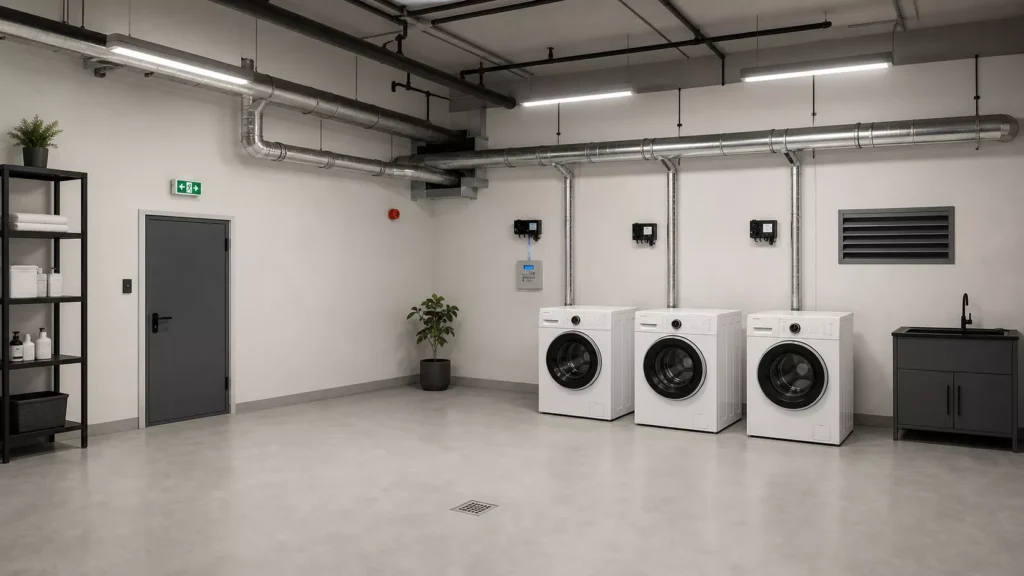
Booster Fans
On a long vent run, the dryer's own blower can't push air the full distance, so an in-line booster fan does the work for it. As a rough guide, one gets fitted when the run goes beyond roughly 25 feet with no bends, 20 feet with one, or 15 feet with two, because every elbow adds resistance equivalent to several feet of straight pipe.
Booster fans get cleaned with everything else because they're the component most likely to fail. Lint builds up on the blades, the fan works harder against a restricted line, and eventually it burns out. When it does, the vent goes from restricted to effectively blocked, and most people don't notice until drying times fall off a cliff.
If there's a fan in your line, we clean the housing and blades and check it's actually running.
HIGH-RISE EXPERTISE
Condos and Shared Exhaust Stacks
Condo laundry is a different problem from house laundry, and it's the one we see most in this city.
In a lot of buildings, several units' dryers feed into a single shared exhaust stack. That stack is longer, has more turns, and carries lint from more than one household. It's also the reason condo setups are the ones most likely to have both a secondary lint trap and a booster fan fitted.
What that means for you in practice: your vent can be restricted through no fault of your own, and the part of the system inside your unit may be short enough that cleaning it alone doesn't fix anything. Where the problem is in the shared stack, that's building maintenance rather than a unit-level job, and we'll tell you that instead of charging you for a clean that won't change your drying times. We can also talk to your building manager directly.
Practical notes for condo appointments: let us know if the service elevator needs booking, and tell us if the dryer is stacked or built into a closet, since getting behind it is often the slowest part of the job.

THE DRYING PROCESS
How Often
Once a year suits most households. Every six months if you run multiple loads a day, or if you have a long vent run, which in practice means most condos and townhouses.
The secondary lint trap is the exception, and it's worth repeating: that one wants checking monthly, and you can do it yourself in about two minutes once you know where it is.
The one thing that makes the biggest difference between cleanings costs nothing. Empty the lint screen after every load, not every few loads.


