

Transparent Pricing
Simple Pricing & Custom Quotes
Every home is different. We provide custom quotes based on your home's size, layout and specific needs - so you get the right service at the right value.
|
Service
|
Price
|
|---|---|
|
Tile and grout cleaning |
Square footage |
|
Bathroom |
Flat rate per room |
|
Kitchen |
Flat rate per room |
|
Natural stone |
Square footage |
|
Grout sealing |
See note below |
|
Booked with carpet cleaning |
Discounted |
You get the final number before we start. We measure and look at the grout first, then confirm the price at your door. Nothing is added without you agreeing to it.
What Changes the Price?
Tile is priced by area, but three things move it from there.
How big your tiles are
house Counter-intuitive but true: small tiles cost more per square foot than large ones, because the work is in the grout and mosaic floors have several times more grout per square foot.
What the tile is made of
checkbox Ceramic and porcelain take pressure and strong cleaners. Marble and travertine etch permanently if anything acidic touches them, so they need gentler products and more passes.
How long since the last clean
wrench Grout that has never been professionally cleaned takes more work than grout done two years ago, and it may not return fully to its original colour.
Send us a photo of the grout.
Close up, in daylight. We can usually tell you what to expect from that alone.
WHY GROUT GOES DARK
Grout Cleaning, and Why It Doesn't Stay Clean
Grout darkens for a reason that has nothing to do with how often you clean.
Cement is porous. Every spill, every wet shoe, every bucket of mop water leaves something in those pores, and after a few years the grout stops reading as a colour and starts reading as a stain. Household mopping accelerates it rather than slowing it down, because a mop redistributes dirty water into the lowest point in the floor and then leaves it there to dry.
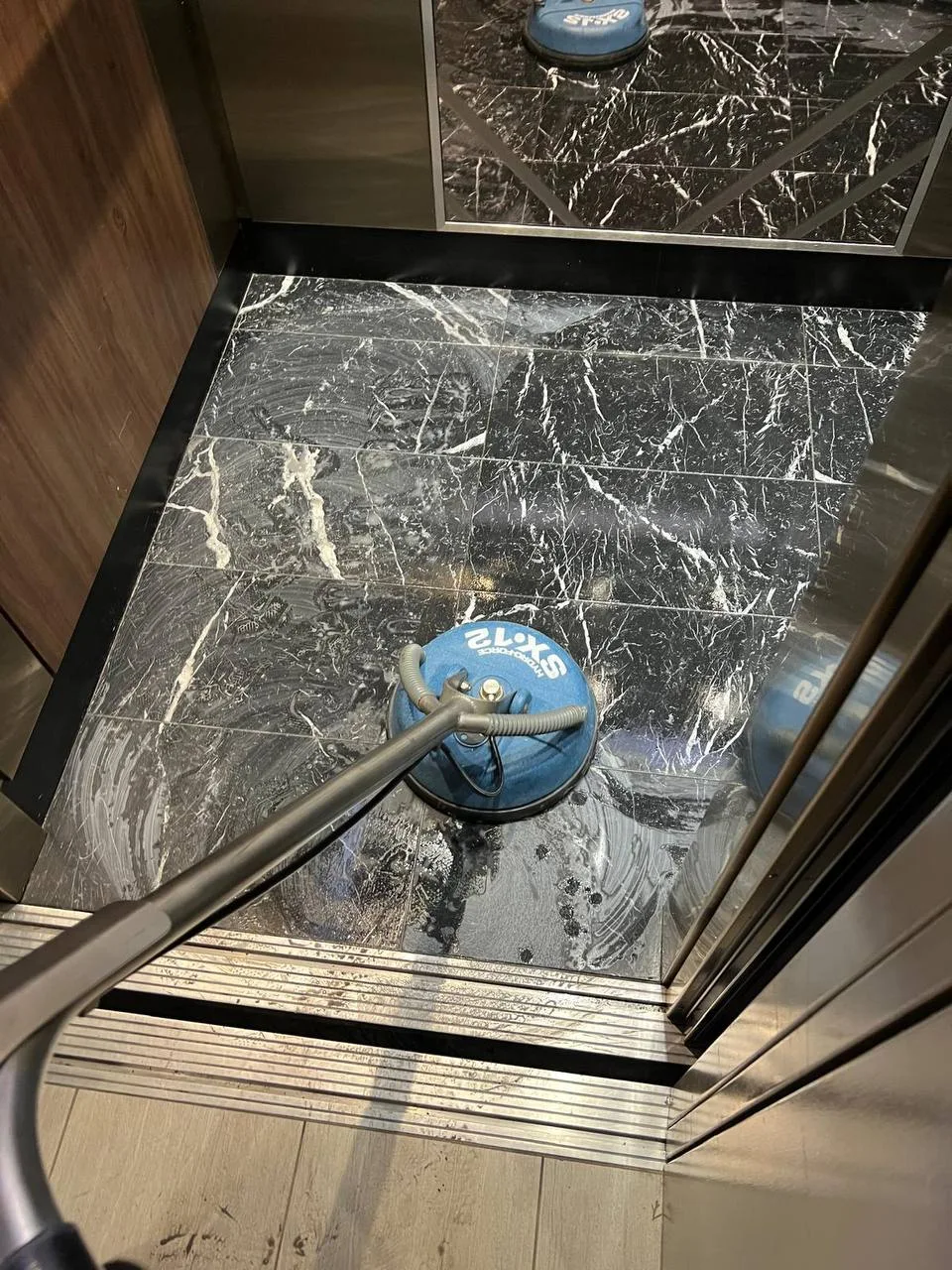
Professional grout cleaning differs in exactly one way that matters: the dirty solution never stays on the floor. We apply a cleaner, give it time to break the buildup down, then remove the solution and the soil together with a pressurised extraction tool.
There's a limit, and you should know it before booking rather than after. If the grout is cracked, crumbling, or was originally dyed a colour that has since worn off, cleaning improves it but won't fully restore it. That's a regrouting job, and we'll tell you during the inspection.
BATHROOMS
Bathroom Tile and Shower Grout
Bathrooms are the hardest room in the house for grout, and what's in there isn't really dirt.
It's a film of soap, shampoo, conditioner and body oils that bonds to the grout and then holds moisture against it. Vancouver makes this specific. Our tap water comes from the North Shore reservoirs and it's naturally soft, so bathrooms here collect far less of the chalky mineral scale that's common in hard water cities. What replaces it is a softer, greasier film that needs a completely different product. Using a descaler on a Vancouver shower is mostly wasted effort.
The film matters beyond appearance. Because it traps moisture in the grout, and because a lot of condo bathrooms in this city are interior rooms with no window and only a ceiling fan, grout can stay damp for weeks at a time through the wet months. That's the condition mildew wants.
A bathroom clean covers:
Floor tile and grout, including around the toilet base and under the vanity
Shower walls, corners and the shower pan
Soap and body oil film that household cleaners leave behind
Sealing once the grout is dry
If mould has grown into a cracked or failed joint rather than sitting on the surface, cleaning won't solve it. That's a regrouting or resealing job and we'll say so.
KITCHENS
Kitchen Tile and Grease
Kitchen floors have the opposite problem to bathrooms.
The buildup here is airborne cooking grease. It settles as a fine layer across the whole floor, then combines with foot traffic and dust into something sticky that ordinary floor cleaner slides straight over. You can usually tell by feel rather than sight: if the floor stays slightly tacky underfoot after it's dried, that's grease, not mop residue. It's also why kitchen grout darkens faster than anywhere else in the house.
We use an alkaline degreaser with enough dwell time to break the grease down before extraction, and we pay particular attention to the places that collect most of it:
The floor in front of the stove and the sink
The strip along the base of the cabinets and the toe kick
Backsplash tile and grout behind the cooktop
Grout under a kitchen island, where a mop has never been
TILE TYPES
What Your Tile Is Made Of
The material decides the method, which is why we identify the tile before choosing anything else. The same pressure and product that's completely safe on porcelain will permanently dull a marble floor.
Ceramic and porcelain
are the most common floors in Vancouver homes and the most forgiving. Both are fired, dense and non-reactive, so they handle higher pressure and stronger alkaline cleaners without risk. Porcelain absorbs almost nothing, which means the dirt is nearly always in the grout rather than the tile.
Natural stone
is a different job. Marble, travertine, limestone and slate are calcium based, and anything acidic etches them: dull patches that can't be cleaned off afterwards, only polished out. These get pH neutral products at reduced pressure. Travertine needs extra attention because its natural pits collect debris a floor tool won't lift on its own, and sealing matters more on stone than anywhere else because the stone itself is porous, not just the grout.
Textured and small-format tile
covers slip-resistant flooring, mosaic and hexagon. They clean up well but they take noticeably longer, which is the main reason a small bathroom can cost more than its square footage suggests.
OUR PROCESS
How the Job Runs
Inspection
Tile material, grout condition, cracks, traffic patterns. This sets the pressure and decides which solution is safe.
Dry soil removal
Loose grit comes off first. Cleaning a floor that still has sand on it just turns the sand into abrasive slurry.
Pre-treatment
Solution onto the grout lines, left to dwell so it can break down grease, soap film and embedded dirt before anything mechanical touches the floor.
Extraction
A pressurised cleaning and recovery tool works the floor section by section, rinsing and vacuuming at the same time so the dirty water leaves with the dirt.
Sealing
Penetrating sealer once the grout is surface dry.
Walkthrough
We go over the floor with you before packing up. One to three hours for most residential floors. Kitchens and bathrooms take longer per square foot than open areas because of the detail work around fixtures.
Want cleaner indoor air without the guesswork?
Get a fast, no-obligation quote from our local Vancouver team.

AFTER THE CLEAN
Drying
Walkable in about 30 minutes, fully dry in one to two hours. This is where tile beats carpet by a wide margin, because extraction takes most of the moisture with it as it goes.
Vancouver stretches that a little. Indoor humidity here stays high through autumn and winter, and an interior bathroom with no window and the fan off can take closer to three hours. Running the exhaust fan or cracking a window handles it.
If we've sealed the grout, keep the floor dry for 24 hours while the sealer cures. That means no mopping and no shower on a sealed shower floor.

BOOK THEM TOGETHER
Tile and Carpet in One Visit
Most homes have both, and doing them in the same appointment costs less than two call-outs.
There's a practical order to it. Tile first, carpet second, because tile work involves more water and more movement, and you don't want traffic crossing a damp carpet to reach the kitchen. If you've got area rugs as well, those come under area rug cleaning and all three can happen in one visit.
Tell us what you've got when you call and we'll work out the sequence.


